
A deposit, known as a down payment, is typically required when purchasing a property in Poland. This guide provides all the key information about mortgage deposits in Poland.
WHAT IS A MORTGAGE DEPOSIT?
A mortgage deposit is the amount of money you pay upfront when purchasing a property. The remainder of the property’s value is typically covered by a mortgage. For example, if you want to buy a property for 800,000 PLN and you have an 80,000 PLN deposit, you would need a mortgage to cover the remaining 720,000 PLN.
You may have heard that there’s a difference between a “deposit” and a “down payment”, but from a mortgage perspective, they mean the same thing. Both refer to the upfront amount paid toward the purchase of a home and are typically expressed as a percentage of the property’s price.
In this article, I will use the terms “deposit” or “mortgage deposit”, but all the information also applies to “down payment.”
WHAT IS LTV?
If you are looking at mortgage in Poland, you will see a lot of jargon used by a mortgage industry. On of the term you will often see is LTV which stands for loan-to-value. It is a percentage of the mortgage amount you borrow to the property value. The difference is typically covered by your deposit.
For example, If you see that a bank borrows up to 90% LTV it means that 90% of the property cost is covered by the mortgage, while 10% is covered by your deposit. The higher the LTV the lower your deposit is and conversely the lower the LTV the higher your deposit is.
HOW MUCH DO YOU NEED FOR A MORTGAGE DEPOSIT IN POLAND?
You may be eligible for a 0% deposit through a government-backed mortgage scheme available in Poland since May 2022.
Read more: 0% deposit – 100% mortgage in Poland
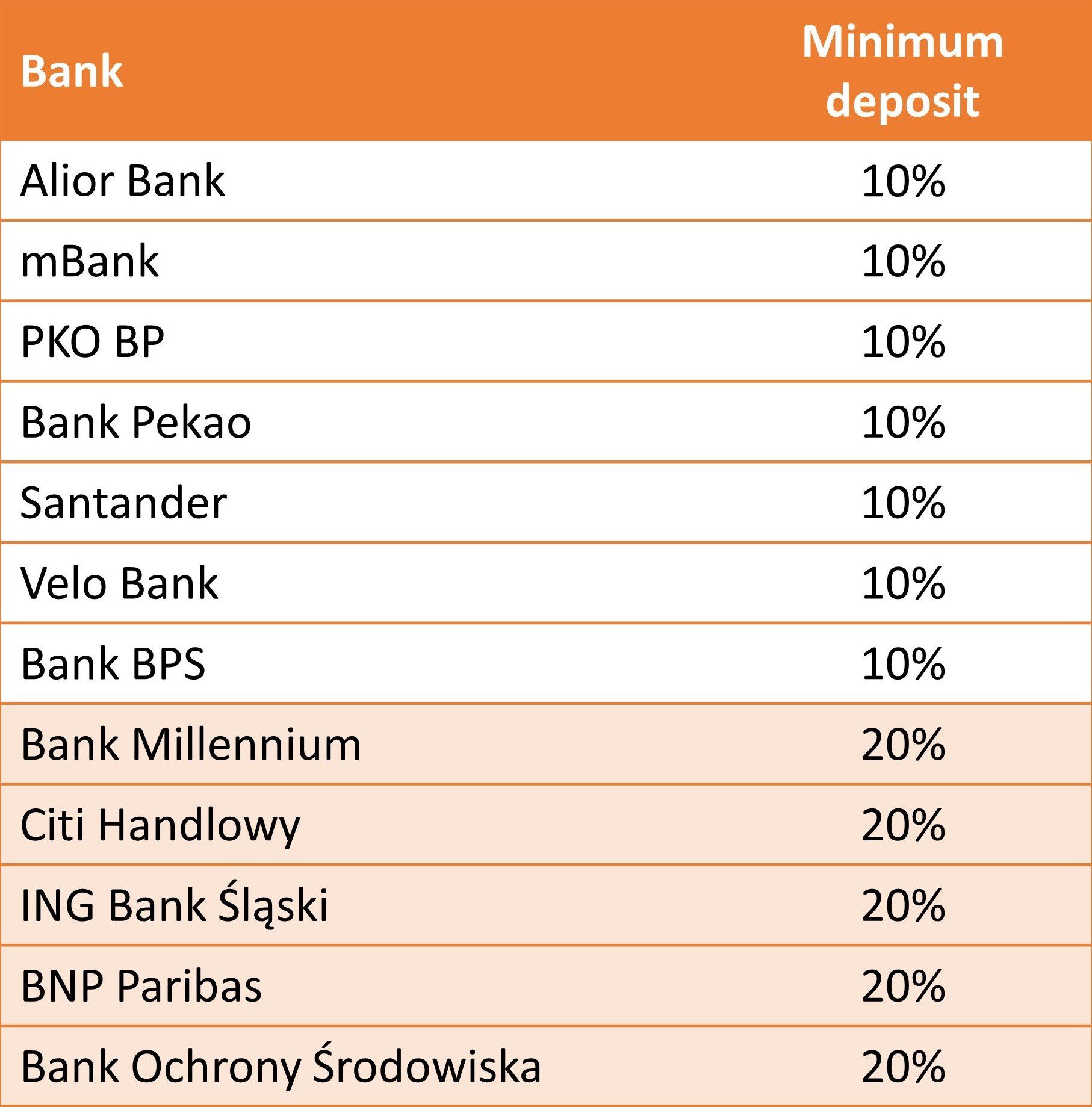
For a normal mortgage the minimum deposit is 10% of the purchase price, but having a 20% deposit or more could help you secure the best mortgage rates. However, some banks require minimum 20% deposit.
The table below shows the minimum deposit requirements at various banks in Poland.
SHOULD YOU AIM FOR A 20% DEPOSIT OR HIGHER?
While 10% is the minimum deposit required for a standard mortgage in Poland, having a 20% deposit or more offers significant advantages.
In Poland, you typically receive better interest rates if you have at least a 20% deposit. For example, if you have an 18% deposit, you’ll likely get the same interest rate as someone with just 10%. Of course, you’ll still benefit from borrowing less and paying less overall interest, but the mortgage offer itself won’t improve unless you reach the 20% threshold.
Benefits of a 20%+ Deposit:
- Access to more banks – Some lenders require a minimum 20% deposit.
- Better mortgage deals – Lower interest rates, often by around 0.5%.
- Lower overall cost – Reduced borrowing amount means less interest paid over time.
- Higher chances of approval – A larger deposit lowers the risk for the bank.
Things to Consider:
While aiming for a higher deposit has clear financial benefits, it’s also important to consider your personal financial situation. In some cases, it may make more sense to:
- Use part of your savings to pay off other debts with higher interest rates.
- Maintain an emergency fund to cover unexpected expenses.
Ultimately, the decision should balance mortgage benefits with your overall financial well-being.
WHEN DO YOU PAY YOUR DEPOSIT?
You typically pay your deposit to the seller before the bank transfers the mortgage funds. Usually, part of the deposit is paid after signing the preliminary agreement, and the remaining amount is paid after signing the final purchase agreement.
Here is a basic example of how it works in Poland:
- You agree to purchase a property for 1,000,000 PLN and plan to borrow 800,000 PLN from the bank. Your mortgage deposit will be 200,000 PLN, which is 20% of the purchase price.
- You sign a preliminary agreement with the seller and transfer 10% of the purchase price—100,000 PLN—as a deposit.
- You apply for a mortgage of 800,000 PLN. After receiving approval, you sign both the mortgage agreement with the bank and the final purchase agreement with the seller.
- After signing the final agreement, you transfer the remaining 100,000 PLN of your declared deposit to the seller. In total, you have now transferred 200,000 PLN—half after the preliminary agreement and half after the final purchase contract.
- You provide proof of both deposit payments to the bank.
- The bank then transfers the remaining 800,000 PLN to the seller—completing the purchase.
- The transaction is finalized.
WHERE CAN YOUR MORTGAGE DEPOSIT COME FROM?
Banks in Poland do not typically require proof of the source of your mortgage deposit. You are not obligated to show that you already have the deposit funds when applying for a mortgage—you simply need to declare the amount you plan to contribute as your deposit.
However, even though banks don’t ask for detailed documentation, you are required to confirm that the deposit does not come from another loan. Under Polish law, you cannot borrow money to use as a mortgage deposit.
This means using a credit card or any form of loan to fund your deposit is not allowed.
Summary of Key Points:
- No need to prove where the deposit comes from
- No requirement to show the deposit amount during the mortgage application
- Cannot use another loan or credit card for your deposit
CAN YOU USE YOUR CURRENT PROPERTY AS A DEPOSIT?
If you already own a property in Poland, you may be able to use the equity in that property as a mortgage deposit when purchasing another one. While most banks in Poland do not allow this directly, it is still possible to offer additional collateral—your existing property—as a substitute for a traditional cash deposit.
The maximum loan-to-value (LTV) ratio in such cases is typically 70%. Here’s how it works:
Example 1: Using a Fully Owned Property as Collateral
- You own a property in Poland worth 500,000 PLN, and there is no mortgage on it.
- You want to buy another property for 500,000 PLN, but don’t have or don’t want to use your savings as a deposit.
- You apply for a 500,000 PLN mortgage, and the bank takes security on both properties—the one you own and the one you’re buying.
- The combined property value is 1,000,000 PLN, and the mortgage is 500,000 PLN, making the LTV 50%.
Example 2: Using Equity from a Mortgaged Property
- You own a property worth 500,000 PLN and still owe 200,000 PLN on your current mortgage.
- You have 300,000 PLN in equity.
- You remortgage your existing loan and borrow an additional 500,000 PLN to purchase another property.
- The result is a new mortgage of 700,000 PLN, secured against both properties, valued at a combined 1,000,000 PLN.
- The LTV is 70%, which is typically within acceptable limits.
Note 1: The property must be located in Poland. Polish banks do not accept overseas property as collateral.
Note 2: Even if you use your current property as additional collateral, you still need to meet the bank’s mortgage affordability criteria. This means the bank will assess your income, expenses, existing debts, and overall financial situation to ensure you have the capacity to repay the loan.
Building a House: Using Land as a Deposit
If you own land in Poland and want to build a house, you can use the land’s value as a deposit. In this case, all banks in Poland accept this setup. The maximum LTV is 90%.
Example:
- Land value: 100,000 PLN
- Mortgage needed for construction: 900,000 PLN
- Total value (land + future house): 1,000,000 PLN
- LTV: 900,000 / 1,000,000 = 90%
This is a common method for financing self-build projects in Poland.
Related Articles
Can a Foreigner Get a Mortgage in Poland?