
Poland has become one of the most popular property markets in Europe. Many foreigners buy apartments in Warsaw, Kraków, Wrocław, Gdańsk, and other cities. Prices are still lower than in many Western countries, and the market has been growing for years.
The good news is simple: yes, foreigners can buy property in Poland.
But there is one important detail that many people miss: in some cases you may need a special permit. And if a permit is required and you buy without it, the purchase can even be legally invalid.
This article explains the key rules in a clear and practical way.
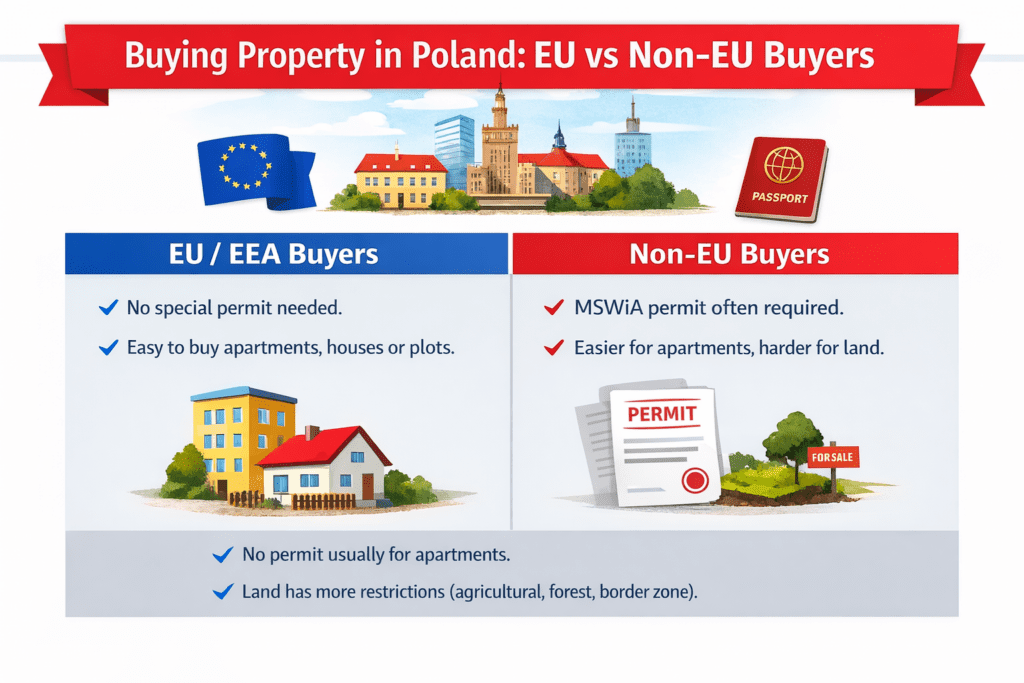
The most important difference: EU vs non-EU buyers
Polish law treats foreign buyers differently depending on where they come from.
If you are a citizen (or business) from the EU, EEA, or Switzerland, you can usually buy property in Poland without any special permit.
If you are from outside the EU, you may need a permit from the Polish Ministry of Interior (MSWiA). That said, there are important exceptions, and the rules are often more friendly than people expect – especially when it comes to apartments.
Who is considered a “foreigner” under Polish law?
This point is important because the legal definition is broader than most people think.
A “foreigner” is not only a person without Polish citizenship. It can also be a company registered outside Poland. And in some cases, even a company registered in Poland can be treated as a foreign buyer if it is controlled by foreigners.
So creating a Polish company does not automatically solve the problem. If foreigners control the company, it may still fall under the same legal restrictions.
Buying an apartment: usually the easiest option
For most foreigners, buying an apartment in Poland is the simplest and safest path.
EU citizens can buy an apartment without any permit.
Non-EU citizens can also often buy an apartment without a permit, as long as the apartment is an independent residential unit and it is located outside the official border zone.
There is one practical detail worth mentioning. When you buy an apartment, you usually also buy a share in the land under the building. This is completely normal and usually does not create problems.
However, sometimes an apartment purchase includes additional land plots, such as a separate access road. In those cases, the permit requirement may come back. This is why it is always worth asking the notary or the seller one simple question before signing:
Does the purchase include any separate land plot?
Buying a house or a plot: land is where restrictions start
A house purchase almost always includes land, and land is where most legal restrictions start for foreign buyers.
If you are from the EU, you can buy a house or a building plot without an MSWiA permit.
As a general rule, if you are from outside the EU, you need an MSWiA permit when buying a house, land, or commercial property in Poland. In practice, many non-EU buyers are surprised that buying a house can be harder than buying an apartment – but the reason is simple: a house means land, and land is treated more strictly.
There is one important exception. In some cases, non-EU citizens who have permanent residence in Poland (or EU long-term resident status) and who have lived in Poland for a certain period of time may be able to buy land without an MSWiA permit. The exact conditions depend on the property type and location, so it should always be confirmed before signing.
Agricultural land: a separate set of rules (UKUR / KOWR)
Even if an MSWiA permit is not required, a purchase may still be restricted by a separate law regulating agricultural land. This law is commonly referred to as UKUR.
The main idea behind UKUR is to protect farmland and prevent speculative purchases. Because of this, agricultural land can often only be bought by an “individual farmer.” If the buyer is not a farmer, the purchase may require consent from KOWR, the National Support Centre for Agriculture.
Two thresholds are worth remembering. UKUR usually does not apply if agricultural land is smaller than 0.3 ha. In some situations, KOWR consent is required for agricultural land of 1 ha or more.
Another important point is that KOWR may have a statutory right to step into the transaction and buy the land instead of the buyer. This is known as a pre-emption right. It can happen even if the seller wants to sell to you.
Forest land: another special regime
Forest land is regulated separately. If the land is classified as forest (or sometimes even planned for afforestation), the Polish State may have a statutory right of pre-emption as well.
This is handled through the State Forests authority (Lasy Państwowe). It is not a “small formality.” If the required notifications are not done correctly, the transaction can be legally invalid.
The border zone: a detail that can change the rules
Poland has an official border zone defined by law. In this area, stricter rules apply, and some buyers (especially non-EU citizens) may not be allowed to purchase property. If you plan to buy property close to the border with Germany, the Czech Republic, Slovakia, Ukraine, Belarus, Lithuania, or Russia (Kaliningrad), it is worth checking whether the property is located in the border zone.
How the MSWiA permit works (if you need one)
If an MSWiA permit is required, it must be obtained before the final purchase.
The process is started by the foreign buyer and usually includes information about the buyer, the property, the seller, and the purpose of the purchase. In many cases, the buyer also needs to provide documents showing their ties to Poland.
Foreign documents often require certified translations.
As a general reference, the typical fees are around 1570 PLN for the permit and 98 PLN for a promissory decision (promesa). A permit is typically valid for two years, and a promesa is valid for one year.
What to check before signing anything (simple checklist)
Before signing a preliminary agreement or paying a deposit, it is smart to verify the basic legal status of the property. In most cases, this includes checking the Land and Mortgage Register (Księga Wieczysta), land classification in official records (EGiB), and the local zoning plan (MPZP).
Depending on the property, it may also be necessary to check additional documents, for example:
- Seller’s title (how the seller acquired the property), especially if it was through inheritance or donation
- Housing cooperative certificate (for cooperative apartments), confirming that a Land Register (KW) can be created
- Road access and easements, especially when buying land
- Utilities and connections (water, electricity, sewage)
- Building documentation (mainly for houses or newer buildings)
You should also confirm whether you need an MSWiA permit, and whether agricultural (KOWR) or forest land restrictions apply. If any statutory pre-emption right is involved, the sale may need a conditional structure and more time.
A Polish notary will usually help verify the key legal documents, but it is still worth checking the main risks before paying any deposit.
Finally, if you need a mortgage to finance the purchase, it is best to check your mortgage eligibility before signing a preliminary agreement.
Conclusion: yes, you can buy property in Poland – but land changes everything
Foreigners can legally buy property in Poland, and for many people the process is straightforward.
In practice, the easiest scenario is usually buying an apartment. Buying land, a house, or agricultural property is where most restrictions start, especially for non-EU buyers.
If you want to buy a house, a plot, or any type of land, it is worth checking the legal requirements early – before paying a deposit or signing an agreement.
FAQ: Buying property in Poland as a foreigner
Do foreigners have the right to buy property in Poland?
Yes. Foreigners can legally buy property in Poland, but some purchases require a permit, especially when land is involved.
Do EU citizens need a permit to buy property in Poland?
In most cases, no. EU, EEA, and Swiss citizens can usually buy property in Poland without any special permit.
Can a non-EU citizen buy an apartment in Poland?
Often yes, and in many cases without a permit. This usually applies if the apartment is an independent residential unit and is located outside the official border zone.
Can a non-EU citizen buy a house in Poland?
Yes, but it is often more complicated. A house purchase includes land, and non-EU buyers often need an MSWiA permit for land.
Can foreigners buy land in Poland?
Yes, but land is the most restricted category. Non-EU buyers often need a permit, and agricultural or forest land may trigger additional rules.
What happens if I buy property without a required permit?
If a permit was required and you bought without it, the transaction may be legally invalid. This is why it is important to check the requirements before signing.
Do I need an MSWiA permit if I have permanent residence in Poland?
Not always. In some cases, non-EU citizens who have a permanent residence permit in Poland (or EU long-term resident status) and who have lived in Poland for a certain period of time may qualify for a statutory exemption and buy property without an MSWiA permit. The exact conditions depend on the type and location of the property, so it should be confirmed before signing.
This article is for general information only and does not constitute legal advice. For a specific transaction, consult a Polish notary or lawyer.